
Pressure ·
Mikel Arteta MIND TACTics: Turning pressure INTO power
Mikel Arteta mind tactics turned Arsenal pressure into power through identity, connection, vigilance and emotional control.
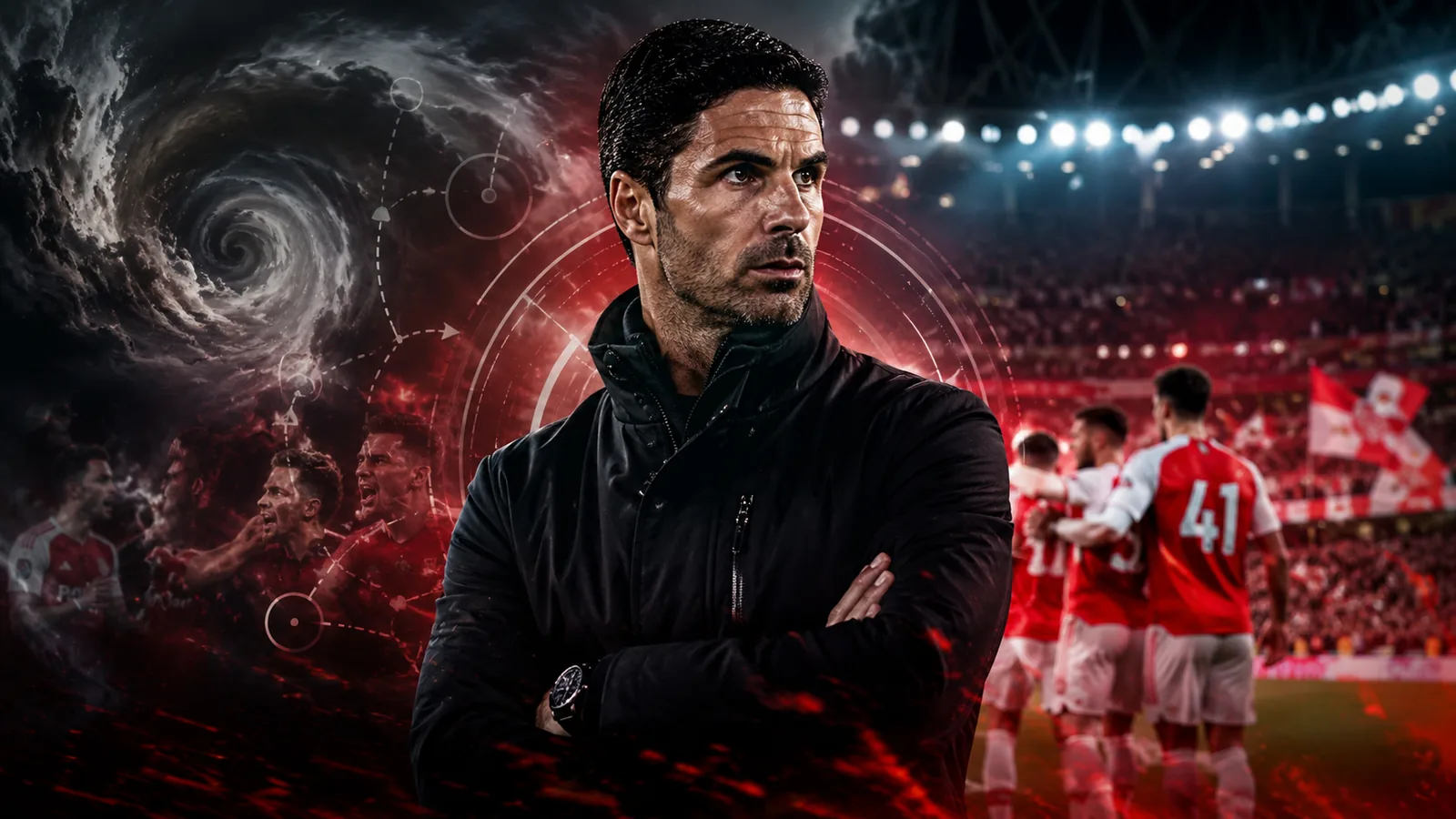
For years, Arsenal carried the weight.
Not just the weight of fixtures. Not just the weight of opponents. Not just the weight of Manchester City breathing down their neck.
A deeper weight.
The weight of almost. The weight of nearly. The weight of a club haunted by its own history.
The Invincibles had become mythology. Highbury had become memory. The badge still burned, but the team had lost something harder to measure than points.
It had lost its inner authority.
Then came Mikel Arteta.
Not simply as a coach. Not simply as a tactician. But as a builder of states.
He did not just ask Arsenal to play differently.
He asked them to become different.
And in 2026, Arsenal finally broke through, securing their first Premier League title since 2004 after a 22-year wait. Sky Sports reported that Arteta’s side ended the drought after Manchester City’s draw at Bournemouth made Arsenal uncatchable with one game remaining.
But this title was not built only on formations, pressing triggers, recruitment, set pieces or defensive structure.
It was built in the mind.
Let’s go into Mikel Arteta Mind Tactics in greater detail.
The first battle was identity
When Arteta arrived, Arsenal were not just underperforming.
They were uncertain.
A team can survive poor form. It cannot survive confusion.
So Arteta began where every great mind coach begins.
With standards.
Respect. Commitment. Passion.
Words, yes. But under Arteta, they became laws. Sky Sports previously reported Arteta describing respect, commitment and passion as “non-negotiable” values at Arsenal.
This matters.
Because athletes under pressure do not rise to slogans. They fall to their standards.
When pressure hits, the nervous system searches for something solid. A clear identity. A code. A line that cannot be crossed.
Arteta gave Arsenal that line.
He made the club feel again like a place where behaviour mattered. Where energy mattered. Where how you walked into training mattered. Where the small details were not small.
They were the architecture of belief.
He Trained Connection Before He Trained Control
One of Arteta’s most famous moments came in All or Nothing, when he held up a light bulb.
To many, it looked strange.
To the warrior mind, it was obvious.
A bulb alone is nothing. Connected, it shines.
FourFourTwo reported that Arteta used the light-bulb metaphor in a team talk, calling on his players to become connected and create energy together.
This was not theatre for theatre’s sake.
It was nervous-system coaching.
A disconnected team plays as eleven isolated bodies. A connected team breathes as one organism.
Under pressure, connection is medicine. It reduces fear. It sharpens trust. It lets a player receive the ball not as a lonely man, but as part of a living structure.
That is why Arteta’s symbolism mattered.
He understood that before a player can execute under pressure, he must feel part of something bigger than himself.
The mind relaxes when it belongs.
He Made Pressure Familiar
Arteta’s methods have often been mocked because they are unusual.
The speakers at training. The metaphors. The emotional team talks. The hidden lessons.
But elite performance is not built in comfort.
It is built by rehearsing the storm before the storm arrives.
Before a match at Anfield, Arteta famously played “You’ll Never Walk Alone” through speakers during Arsenal training to simulate Liverpool’s atmosphere, a method reported by Goal and later widely discussed after All or Nothing.
To the casual observer, that might look gimmicky.
But from a mind-performance perspective, it is intelligent.
The brain fears what it has not rehearsed.
Noise. Hostility. Emotional surge. The sudden tightening of the chest when the crowd rises. The split second where the athlete loses presence and reacts instead of responds.
Arteta tried to bring that future pressure into the present.
Not to scare his players.
To inoculate them.
This is pressure training. This is exposure. This is teaching the body: we have been here before.
Champions are not people who feel no pressure.
Champions are people who have made pressure familiar.
He Taught Vigilance
Then came the pickpockets.
Arteta reportedly hired professional pickpockets to steal items from Arsenal players during a team dinner, later revealing the lesson: stay alert at all times. The Times reported the tactic in 2024, describing it as a lesson in vigilance.
Again, some laughed.
But beneath the theatre was a performance truth.
Football at the highest level is decided by attention.
One lapse. One shoulder not checked. One second of emotional drift. One mental switch-off after a missed chance.
And the game turns.
Arteta was not teaching his players about wallets.
He was teaching them about presence.
The warrior is not tense. The warrior is awake.
That is the state Arteta wanted: alert, alive, aware.
The body relaxed. The mind sharp. The attention complete.
He softened the environment without weakening the edge
One of the most fascinating Arteta moves was the introduction of Arsenal’s training-ground dog, a chocolate Labrador named Win.
ESPN reported that Win became part of the Arsenal environment and had a positive effect on morale around the club. Reuters also noted Win as part of Arteta’s broader culture-building work, alongside unity, accountability and symbolism.
This is where Arteta’s emotional intelligence appears.
He was not trying to create a cold machine.
He was trying to create a high-trust organism.
Elite athletes do not perform best when they are constantly hardened. They perform best when they can move between intensity and safety. Between edge and ease. Between fire and recovery.
Win, the dog, represented something deeper than morale.
A nervous system reset. A reminder of warmth. A touch of innocence in a brutal industry.
The best performance cultures are not built on fear.
They are built on demanding standards held inside emotional safety.
Arteta seemed to understand this.
He wanted warriors.
But not frozen ones.
He turned Arsenal from talent into belief
For three straight seasons, Arsenal had lived near the summit. Close enough to see the trophy. Close enough to taste it. Close enough for the failure to hurt.
That kind of repeated near-miss can break a team.
It can create doubt. It can whisper: not again. It can poison the final stretch of a season.
But Arteta kept shaping the story.
Reuters described his rebuild as a transformation of Arsenal’s culture through symbolism, unity and accountability, noting that the club’s long-term trust in his vision was validated by the 2025–26 Premier League title.
That is the key word.
Vision.
A team must see itself before it becomes itself.
At first, Arteta’s Arsenal had to imagine being champions. Then they had to behave like champions. Then they had to suffer like champions. Then, finally, they could stand as champions.
This is how identity is formed.
Not in one speech.
In repetition.
The same standards. The same language. The same emotional cues. The same demand for presence. The same refusal to collapse into the old story.
Arsenal did not simply win the league.
They outgrew their old self.
The real tactic was state control
Look at the pattern.
The light bulb was connection. The Anfield speakers were pressure rehearsal. The pickpockets were vigilance. The dog was emotional regulation. The slogans were identity anchors. The standards were behavioural law.
Different methods.
One purpose.
Control the state before the performance.
That is the mind-performance lesson.
The body follows the state.
A fearful state produces hesitation. A scattered state produces poor decisions. A disconnected state produces selfishness. An overhyped state produces chaos. A grounded state produces clarity.
Arteta’s genius was not just that he prepared Arsenal tactically.
It was that he prepared them emotionally.
He built a team that could stay awake in noise. Stay connected in tension. Stay loyal to standards in fatigue. Stay clear when history pressed its hands around their throat.
The champion is built before the trophy arrives
The world sees the lift.
The medals. The noise. The red shirts. The release.
But the title was won earlier.
In the training ground. In the team meetings. In the strange metaphors. In the hard conversations. In the emotional resets. In the repeated demand to be more present, more connected, more alive.
Arsenal became champions because Arteta understood something many coaches forget:
The game is not only played on grass.
It is played in the nervous system.
It is played in the space between mistake and response. Between pressure and panic. Between noise and breath. Between history and now.
Arteta did not remove pressure from Arsenal.
He changed their relationship with it.
And that is the true mark of a mind coach.
Not to make athletes comfortable.
But to make them capable.
To stand in the fire and not become frantic. To feel the weight and not collapse. To carry the dream without being crushed by it.
Arsenal’s 2026 title was not just a football triumph.
It was a psychological resurrection.
A club that had been haunted by almost finally became anchored in enough.
Enough belief. Enough discipline. Enough connection. Enough presence.
The trophy came last.
The mind came first.