
Skills ·
The Mental Skills Sport Demands but Rarely Teaches
Football mental training goes beyond telling players to focus or calm down. Discover how attention, composure and mental resets can be trained.
The Missing Instruction in Athlete Development
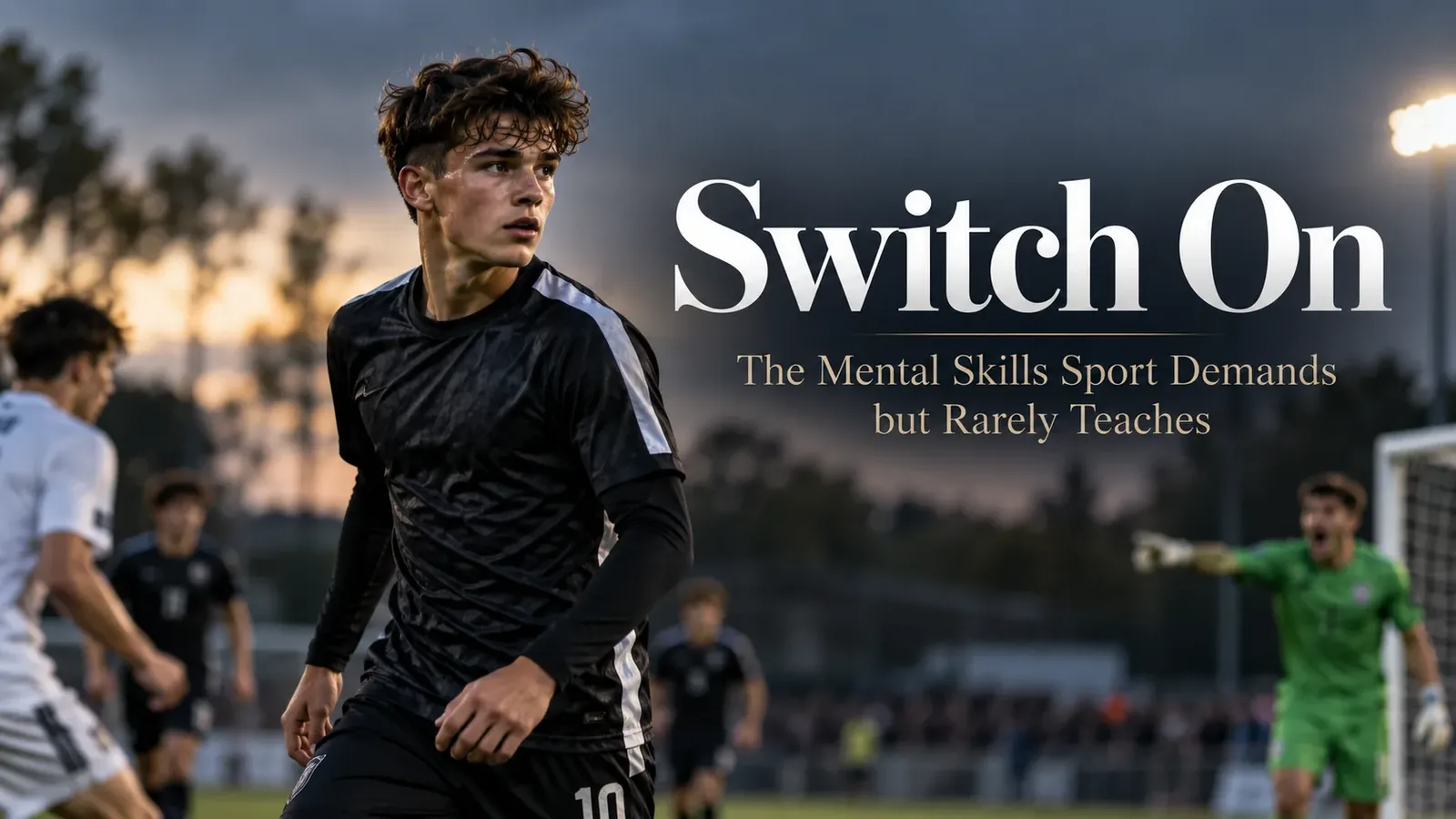
“Switch on!” The goalkeeper screams it across the field. Again. “Switch on!” He can see that his teammates have lost concentration. They are slow to react. Their attention has drifted. The opposition is beginning to find space. The goalkeeper knows something needs to change. But there is a problem.
How, exactly, does a player switch on? What does the athlete actually do? Where do they place their attention? What happens with their breathing? What happens in their body? How do they recognise that their mind has wandered? And once they recognise it, how do they bring themselves back?
These questions reveal one of the great gaps in modern sports coaching. We constantly tell athletes what mental state they should be in, without teaching them how to enter that state.
The Language of Sport Is Full of Mental Commands
Spend enough time around sport and you will hear the same instructions everywhere. “Calm down.” “Focus.” “Stay composed.” “Switch on.” “Relax.” “Be confident.” “Forget about it.” “Stop thinking.” “Stay in the moment.” “Don’t let the pressure get to you.” “Reset.”
These phrases are so deeply embedded in sporting culture that we rarely question them. And often the instruction itself is correct. The athlete does need to become calmer. The defender does need to become more alert. The striker does need composure in front of goal. The tennis player does need to release the previous point.
The golfer does need to stop carrying the last bad shot into the next one. The problem is not necessarily what the coach is asking for. The problem is that nobody has taught the athlete how to do it.
A mental outcome is being demanded without a mental process being taught.
“Be Calm in Front of Goal”
I’ve heard senior coach staff tell attacking players: “Be calm in front of goal.” It sounds like good advice. And technically, it is. A composed striker is more capable of seeing the goalkeeper, recognising space, choosing rather than reacting, and executing the skill without unnecessary muscular tension.
But imagine the player. He breaks through the defensive line. Suddenly he is one-on-one. His nervous system fires. His heart rate increases. His breathing changes. His body tightens. His visual attention can narrow. Thought appears: Don’t miss. Then perhaps: I have to score this. The goalkeeper rushes toward him. The defenders are chasing. The sideline erupts.
And somewhere in the player’s memory sits the coach’s instruction: Be calm. But how? The athlete cannot simply order the nervous system into calmness because someone told him to. In fact, trying desperately to “be calm” can create another layer of tension. Now he is not only experiencing pressure. He is experiencing pressure and believing he should not be experiencing pressure.
That distinction matters.
We Would Never Coach Physical Skills This Way
Imagine coaching a young player who cannot strike a football properly. Would we stand on the sideline screaming: “Kick better!” Again and again? Of course not. We would break the movement down. Plant your foot here. Position your body. Watch the ball. Strike through it. Follow through. Then we would practise. Again. And again. And again.
Until the movement became increasingly available under pressure. We understand this intuitively with physical skills. We teach technique. We create repetition. We progressively introduce pressure. We allow the nervous system to learn. Yet when it comes to the inner game, our coaching methodology often becomes remarkably primitive. Calm down. Concentrate. Be confident. Switch on. These are not techniques.
They are desired outcomes. There is an enormous difference.
The Athlete Needs a Pathway
If we want an athlete to become calm, they need to understand the pathways that influence arousal and regulation. If we want an athlete to become focused, they need to understand attention. If we want an athlete to recover from mistakes, they need to practise disengaging from rumination and returning attention to the present task.
If we want an athlete to perform under pressure, they need opportunities to recognise what pressure actually does inside their body and mind. This is where mental training becomes practical. The breath can be trained. Attention can be trained. Body awareness can be trained. Emotional regulation can be trained. Pre-performance routines can be trained. The ability to recognise thought without automatically following it can be trained.
The ability to return attention to the immediate sensory environment can be trained. The ability to reset after a mistake can be trained. These are not motivational slogans. They are skills. And skills require practice.
“Switch On” Is an Attentional Skill
Consider the goalkeeper screaming: “Switch on!” What is he actually seeing? Perhaps a defender is mentally elsewhere. Perhaps the player’s visual scanning has decreased. Perhaps attention has become narrow or passive. Perhaps the player is still thinking about the previous passage of play. Perhaps fatigue has reduced attentional control. Perhaps anxiety has pulled awareness inward.
“Switch on” is therefore not one thing. It is shorthand for a collection of attentional and physiological processes. Instead of merely demanding the outcome, we can train the process. A player can learn to notice: Where is my attention right now? Then deliberately reconnect with immediate information: Ball. Opposition. Teammates. Space. Body position. Breath. The player can use a physical or verbal reset cue.
One deliberate exhalation. Eyes up. Scan. Reconnect with the field. Now “switch on” has begun to acquire a mechanism. Instead of being an emotional demand shouted from twenty metres away, it becomes a trained sequence the athlete recognises. Notice. Reset. Scan. Re-engage. That can be practised. And what is practised repeatedly becomes more accessible when pressure arrives.
Calm Is Not Something We Demand
There is another important distinction. Calmness does not necessarily mean feeling completely relaxed. Elite performance often requires significant activation. The athlete may have adrenaline moving through the body. Their heart may be beating quickly. Energy may be high. The goal is not always to eliminate activation. It is to develop the capacity to remain clear within activation.
This is a very different definition of calm. Calm is not necessarily the absence of intensity.
Calm can exist inside intensity.
A boxer can be calm while facing danger. A goalkeeper can be calm during a penalty. A striker can be calm while sprinting toward goal. A tennis player can be calm at match point. The body can be highly activated while awareness remains clear. That is what athletes need to experience in training. Not an intellectual definition of composure.
The lived experience of it.
You Cannot Think Your Way Out of Every State
One of the mistakes we make in sport is assuming that because an athlete understands an instruction cognitively, they can immediately implement it physiologically. But knowing that you should relax is different from possessing the ability to regulate tension.
Knowing that you should concentrate is different from recognising where your attention has gone and knowing how to redirect it. Knowing that you should “forget the mistake” is different from understanding how to interrupt rumination. The nervous system learns through experience.
Which means mental skills training cannot exist only in team talks, motivational speeches or tactical whiteboards. It has to enter the body. It has to be practised. An athlete needs to discover: This is what tension feels like. This is what my breathing does under pressure. This is what happens when my attention collapses inward.
This is what frustration feels like before it takes over. This is how I return. That last sentence may be one of the most important skills in sport: This is how I return.
Presence Is a Trainable Sporting Skill
At the centre of many of these abilities is something remarkably simple: Awareness. Can the athlete notice what is happening while it is happening? Can they recognise tension before tension becomes panic? Can they recognise frustration before frustration becomes aggression? Can they notice that their mind is replaying the mistake? Can they notice that their attention has disappeared into the future?
Can they recognise the thought: What if I miss? without allowing that thought to consume the next moment? This is where mindfulness and meditation become profoundly relevant to sport. Not as relaxation exercises. Not as spiritual decoration. Not as something athletes do because meditation has become fashionable.
Meditation can become a laboratory in which the athlete learns the mechanics of their own attention. Sit. Breathe. Attention wanders. Notice. Return. It wanders again. Notice. Return. Again. Again. Again. At first glance this can seem far removed from competition. It isn’t. Because sport continually asks the athlete to do precisely the same thing. The referee makes a bad decision.
Attention leaves the game. Notice. Return. You miss an easy opportunity. The mind begins replaying it. Notice. Return. The crowd becomes hostile. Attention becomes captured. Notice. Return. You begin thinking about the result with ten minutes remaining. Notice. Return. Pressure produces thoughts about failure. Notice. Return. Meditation trains the return. Competition reveals whether you have learned it.
The Breath Is a Bridge
The breath deserves particular attention because it occupies a unique position in human physiology. Breathing happens automatically. But it can also be consciously influenced. That makes it an extraordinarily useful bridge between conscious intention and physiological state. An athlete cannot simply command: “Heart rate, slow down.” But the athlete can work with breathing. They cannot directly command:
“Nervous system, regulate yourself.” But they can develop breathing practices and embodied routines that help influence their state. This is why telling someone to “calm down” is fundamentally different from teaching them a practised regulation strategy. One is an instruction. The other is a skill.
Training the Inner Game Before the Moment Arrives
The middle of competition is not the ideal time to introduce a psychological skill. That is where the skill is tested. Training is where it should be learned. We would never introduce a completely new technical movement during a championship final and expect mastery.
Yet athletes are frequently expected to regulate emotions, control attention and handle enormous psychological pressure without having systematically practised those abilities. Mental skills should therefore be integrated into normal training environments. Before drills. During drills. Between repetitions. After mistakes. During fatigue. Under simulated pressure. Players can practise a ten-second reset after an error. They can practise deliberate breathing before a penalty.
They can practise widening visual awareness when anxiety narrows attention. They can practise recognising tension in the shoulders, jaw and hands. They can practise returning from internal thought to external information. Eventually the coach’s language changes. Instead of: “CALM DOWN!” the coach can say: “Reset.”
And because reset has been trained hundreds of times, the athlete knows exactly what it means. Breath. Release unnecessary tension. Eyes up. Reconnect. Next action. Now one word carries an entire trained process. That is coaching.
Coaches Need to Teach the How
This is not an attack on coaches. Coaches themselves have rarely been taught these skills. Many grew up inside sporting systems where psychological coaching consisted largely of motivation, toughness and instruction. “Want it more.” “Concentrate.” “Don’t be nervous.” “Stay positive.” “Be mentally strong.” The language has been inherited. So the opportunity is not to blame coaches.
It is to equip them. Imagine if grassroots coaches understood basic attentional training. Imagine if junior athletes learned emotional awareness alongside technical development. Imagine if a 14-year-old footballer understood what adrenaline feels like and knew that its presence did not mean something was wrong.
Imagine if young athletes were taught how to breathe, reset and reconnect after mistakes. Imagine if coaches possessed a common language for these skills. We would begin developing athletes who do not merely hear: “Control yourself.” They understand how to work with themselves. That difference reaches far beyond sport.
From Commands to Skills
Sport needs to make a fundamental shift. From: “Be calm.” to: “Here is how we train regulation.” From: “Focus.” to: “Here is how attention works, and here is how we train it.” From: “Forget the mistake.” to: “Here is your reset process.” From: “Be confident.” to: “Here is how preparation, self-talk, imagery, attention and repeated experience contribute to confidence.”
From: “Switch on.” to: “Notice. Breathe. Scan. Reconnect.” From: “Stay present.” to: “Here is what presence feels like, and here is how we practise returning to it.” This is the evolution required in mental performance coaching. Because an athlete cannot consistently execute a skill they have never been taught.
The Moment Before the Moment
There is a moment before the penalty. A moment before the serve. A moment before the starting gun. A moment after the mistake. A moment when anger begins rising. A moment when fear enters the body.
A moment when the mind leaves what is happening and disappears into what might happen. This is where the inner game lives. The athlete who has never explored these moments is left largely to instinct and chance. The trained athlete has another possibility. They recognise what is happening. They feel the ground. They meet the breath.
They release what does not need to be carried. They see again. And they return. Not because somebody screamed “SWITCH ON!” But because they have trained themselves to know the way back. That is the missing lesson. We have spent generations telling athletes where their minds need to be. It is time we taught them how to get there.